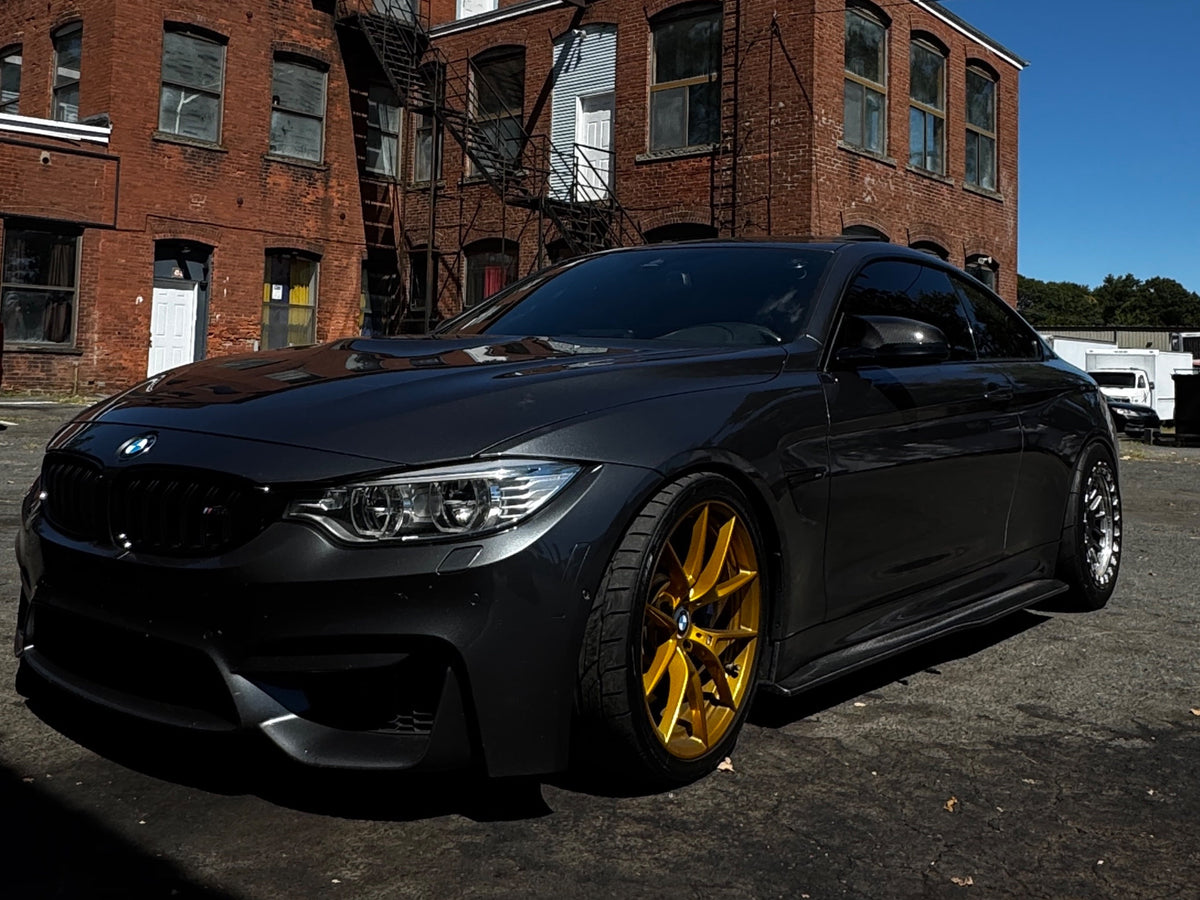
The BMW F82 M4 with the S55 twin-turbo engine is genuinely impressive from the factory. 425 horsepower, twin turbocharged, instant throttle response, and a chassis that rewards every input with the kind of feedback that makes you look for any excuse to drive it.
It is also, for a certain type of BMW enthusiast, not enough.
The stock twin-turbo setup on the S55 has a ceiling. Not a low ceiling, but a ceiling. Every modification has been done and every tune has been run and the community knows broadly what a fully built S55 twin-turbo M4 can achieve. That ceiling exists and serious builders who want to go beyond it have one option.
Remove the twins. Install a single.
We completed exactly this build on a customer's F82 M4 using a full bottom mount single turbo kit from 4N Motorsports built around a Borg Warner turbocharger. The build took four days. The dyno session produced results that answered the question every BMW enthusiast watching this build wanted answered from day one.
Here is the complete story.
Why Anyone Removes Factory Twin Turbos From an Already Fast Car
The S55 twin-turbo arrangement on the F82 M4 is a genuine engineering achievement. Two turbos, tightly packaged in an already crowded engine bay, producing instant response at any RPM because there is always one turbo ready to spool regardless of where in the rev range the engine is operating.
The advantages of the factory twin setup are real. Instant response from idle. Predictable, manageable power delivery that makes the car genuinely fast without being violent. A street manners profile that lets the car function as a daily driver without constantly demanding the driver's full attention.
The limitation is that the stock turbos have a physical flow ceiling. They can only move a finite volume of air, which limits the boost they can produce and the power that boost can generate regardless of how perfectly everything else is built and tuned. A fully built S55 on stock turbos, with every supporting modification correctly in place and a professional tune extracting the maximum, approaches a ceiling that a single large turbocharger simply does not have at the same level of total investment.
The trade the single turbo conversion makes is straightforward in principle and complex in execution. You trade the instant, linear twin-turbo response character for a different kind of power delivery, the build of a single large turbo as boost comes on, the surge of power that arrives and does not stop climbing all the way to the redline. You trade a ceiling for a runway. And you trade everything being in the original location for a complete teardown and rebuild of the engine's entire induction and exhaust system.
That trade is either exactly what an enthusiast wants or exactly what they do not want. There is very little middle ground.
The 4N Motorsports Bottom Mount Single Turbo Kit
The kit that went into this build is a 4N Motorsports bottom mount single turbo system centered on a Borg Warner turbocharger. The bottom mount configuration positions the turbocharger lower in the engine bay than the stock twin arrangement, which affects packaging, response characteristics, and the routing of every oil, coolant, and exhaust connection that ties the new turbo into the existing systems.
The manifold that comes with the 4N Motorsports kit is an equal length tubular design, engineered to deliver exhaust pulses from each cylinder to the turbocharger as efficiently as possible. Equal length runners reduce the pulse interference that unequal manifold designs create, which in practice means better turbo response and more consistent spool behavior across the RPM range.
The build quality on the kit is serious. The welds are clean. The engineering decisions reflect a company that has developed this system specifically for the S55 rather than adapted a generic single turbo solution to fit a platform it was not designed for. The difference in kit quality between a properly developed platform-specific system and a generic adaptation shows in how the installation proceeds and how the finished product behaves.
Day One, Confronting the S55 Engine Bay
Day one of the build was the stock turbo removal and it was exactly as demanding as the engine bay packaging suggests it would be.
The S55 engine bay in the F82 M4 is a lesson in how BMW engineers prioritize performance and packaging over service access. Two turbos, charge cooler, oil lines, coolant lines, and a universe of plumbing are compressed into a space that makes getting hands and tools to the relevant hardware a physical challenge from the first moment.
Getting the turbos out starts with the engine bay plastics and braces, which require an E12 socket for the first brace and an E16 for the hardware holding the next layer of components. The charge pipes come out after the intakes, which are in the way of accessing the charge pipe hardware. The O2 sensors get unplugged before any pipe moves. Then the work goes underneath the car, where removing the passenger wheel gives the best access to the downpipe connections and the turbo mounting hardware.
Disconnecting the downpipes means working in positions that require reaching around and behind components with sockets on extensions in spaces that were never intended to be accessed during maintenance. Removing the motor mount post mount comes next to create additional clearance. The turbos themselves, once every connection is free, still require significant maneuvering to extract from the packed engine bay.
This is not a job for someone without genuine BMW engine experience. The S55 does not reveal its complexity in descriptions. It reveals it in the reality of the work.
Day Two, The Single Turbo Kit Goes In
With the stock twins out, day two was the installation of the 4N Motorsports kit, and this is where the build takes on a different character. The removal is about fighting the stock configuration. The installation is about precision and sequence.
Every major component of the kit gets fitted on the bench before it goes anywhere near the car. The manifold and turbocharger assembly gets as much preparation completed away from the engine as possible, since working on components before they are in the car is always more efficient than working on them once installation has begun.
The manifold installs first, and removing the exhaust studs before attempting manifold installation makes the process significantly more manageable. The turbocharger housing is large enough that fitting it in the engine bay requires care about protecting the turbine fins during installation, since replacing a damaged turbocharger because a fin was bent during installation is an expensive and entirely avoidable mistake.
With the turbo and manifold in place, the oil feed and return lines connect to the top and bottom of the turbocharger. The coolant lines follow. The block-off plates cover the ports that were used by the stock twin-turbo system and are no longer needed.
Alongside the single turbo installation, the build addressed several maintenance items simultaneously since the engine was already significantly disassembled. New valve cover and valve cover gasket. New injectors. New ignition coils. New spark plugs, gapped specifically for the boost level this build would run. The philosophy of addressing every item that warrants attention while the engine is already torn down to this level applies here exactly as it does on any major build. Coming back to do deferred maintenance after a single turbo installation means tearing down the same components again. Do it once, do it completely.
The spark plug gap on this build was set to 0.022 inches, tighter than the stock gap of 0.024 inches, reflecting the principle that higher boost pressure requires a tighter gap for reliable ignition. The tuner, Steve from Wedge Performance, specified this gap as the starting point for the tune development.
Before the cold side of the turbocharger was installed, the wastegate actuator rod alignment was set correctly. This is a step that the 4N Motorsports kit documentation covers but that is easy to overlook in the sequence of installation, and getting it wrong requires removing the cold side again to correct. Lining the rod up with the wastegate hole on the hot side before the cold side goes on takes thirty seconds and saves an hour.
Day Three, Assembly and Preparation
Day three completed the installation and prepared the car for its first start and initial driving before the dyno session.
Every component comes together in the final assembly phase, and this is where the thoroughness of the previous two days either pays off or reveals itself in problems. Coolant lines properly routed and secured. Oil lines tight at both ends. The downpipe connected correctly to the new single turbo outlet. The charge piping connecting the turbocharger to the charge cooler and ultimately to the throttle body.
The first startup after a single turbo conversion is one of the more significant moments in any serious BMW build. The engine that started the build as a factory twin-turbo S55 M4 was now fundamentally different in its induction and exhaust architecture. The character of the startup, the idle note, the way the engine responds to initial throttle inputs, are all noticeably different from the stock configuration.
Different is not automatically better at this stage. Different is the opening of a new chapter that the tuning session will complete.
Day Four, The Dyno. Here Are the Real Numbers.
The dyno session at Wedge Performance was approximately one hour away from the shop, and the drive there on an untuned or partially tuned single turbo conversion is exactly the combination of excitement and uncertainty that defines serious performance builds.
The car went on the dyno and the first pull produced 667 wheel horsepower. To put that in context, the stock F82 M4 produces approximately 425 horsepower at the crank, which translates to roughly 370 to 380 wheel horsepower depending on drivetrain losses. The first pull on the single turbo conversion produced 667 wheel horsepower at the wheels.
The tuning session continued as Steve from Wedge Performance worked through the calibration, adjusting boost targets, timing, and fueling to find the car's current potential. Subsequent pulls moved through 676, down slightly as the tune was refined, then back up as the calibration improved.
The final number on the dyno that day was 710 wheel horsepower.
To understand what that number means in practice, consider the comparison the tuner offered on the dyno. Looking at the dyno graph comparing the first pull of the day to the final pull, the car gained 118 wheel horsepower specifically in the mid-range RPM range between 5,500 RPM and redline, entirely through the tuning process during that session, before any further hardware changes. The single turbo's power delivery characteristic, building through the mid-range and continuing to pull hard all the way to the redline, was exactly what the dyno graph showed.
The goal coming into the dyno session was 700 wheel horsepower. The car left with 710. It also left with room for further improvement, since the current tune was a starting point for a platform that has more in it at higher boost levels with appropriate supporting modifications.
Stock Twins vs Single Turbo, The Real Comparison
The question every F82 M4 owner asks when they see a single turbo build like this is not whether it makes more power. The dyno numbers answer that definitively. The question is whether the trade-off in driving character is worth it.
Power ceiling: The stock twin-turbo S55, fully built and properly tuned, is widely documented to reach somewhere in the 550 to 600 wheel horsepower range before the turbochargers become the limiting factor. The single turbo conversion on this build hit 710 wheel horsepower on its first tune day. The ceiling comparison is not close.
Response and character: The stock S55 twin-turbo arrangement provides genuinely instant throttle response at every RPM. Tip into the throttle at 2,000 RPM and there is immediate, linear power. The single turbo setup requires the turbocharger to build boost, which produces a distinct powerband character. The turbo spools, boost builds, and then the power arrives with a surge that continues through the entire RPM range rather than arriving instantly everywhere. This is the difference the tuner described as the shift from instant hit to pull you to redline.
Neither character is objectively better. They are different driving experiences and which one a driver prefers depends on what they are doing with the car. A track driver who enters corners at controlled RPM and wants maximum power from the moment they get back on throttle at corner exit may prefer the single turbo's mid-range surge. A street driver who uses the car in varied urban conditions might prefer the instant response of the factory twins that are always ready regardless of where the revs are.
Cost: A complete, professionally installed single turbo conversion using a quality kit like the 4N Motorsports system, with all supporting maintenance items, tuning, and shop time, represents a significant investment. This is not a bolt-on modification. It is a complete engine transformation that justifies its cost with results that the factory configuration cannot achieve at any price of modification.
Finality: The single turbo conversion is not easily reversed. It is a commitment to a different version of the car. The F82 M4 owner who makes this modification is making a statement about what they want their car to be and accepting that it will be that thing permanently unless an equivalent effort is made to reverse it.
Watch the Full Four Day Build
The complete F82 M4 single turbo conversion is documented across a four-part series on the Tysautoworks Performance YouTube channel. Every day of the build from removing the first stock turbo through the dyno session and the final 710 wheel horsepower pull is filmed and available to watch.
Subscribe to Tysautoworks Performance on YouTube for more real BMW builds documented from first bolt to final dyno pull.