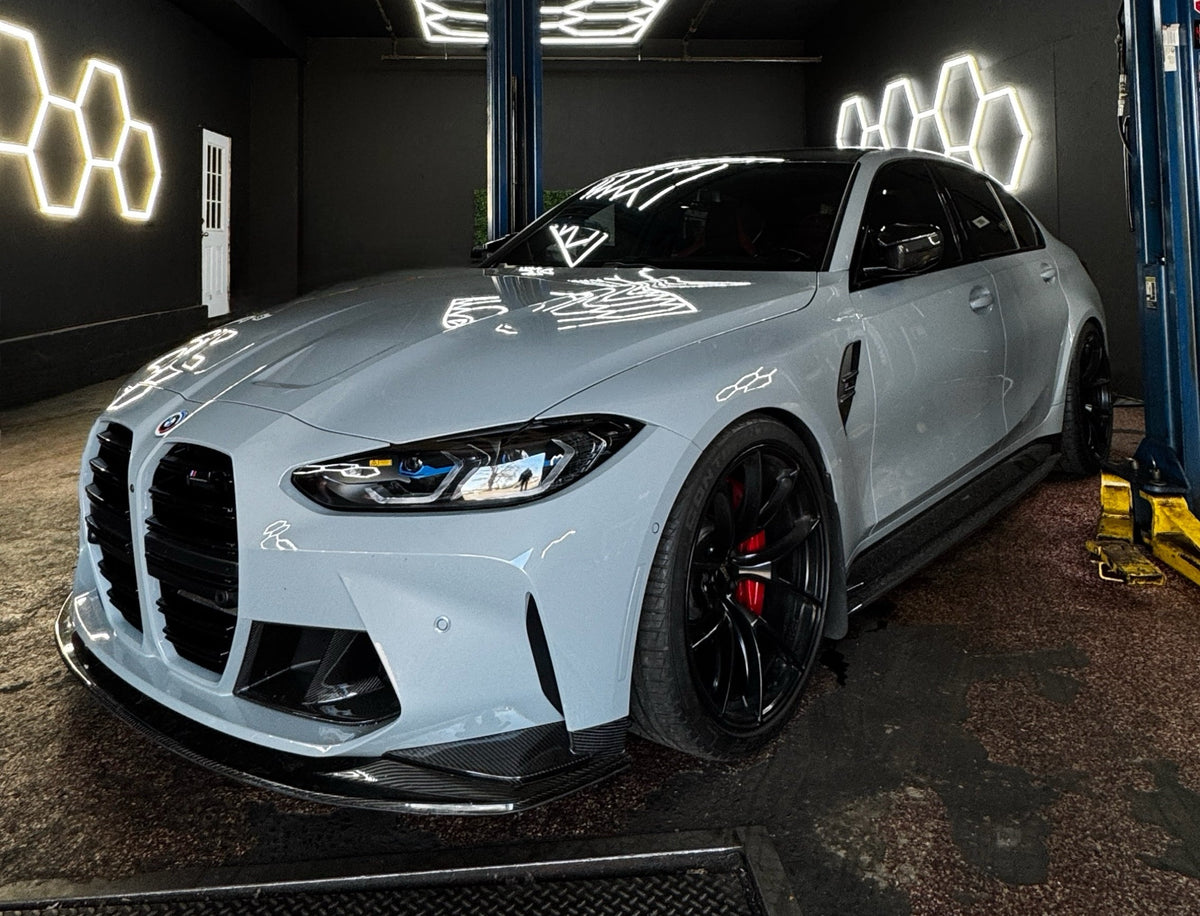
Connecticut BMW owners who are serious about performance tuning know that a tune is not the starting point. It is the finishing touch on a build that was designed correctly from the beginning.
The online BMW community is full of enthusiasts who installed a tune on an otherwise stock car, saw modest gains, and wondered why the investment did not produce the transformation they expected. And it is equally full of enthusiasts who built their car correctly first, added a tune as the final component of a properly designed system, and experienced exactly the kind of result that makes a BMW ownership story worth telling at every car meet from Hartford to Greenwich.
At Tysautoworks Performance in Meriden, CT, we work with Connecticut BMW owners on performance builds that are designed to be tuned correctly, not retrofitted with a tune after the fact. Here is what performance tuning in Connecticut actually involves when it is done the right way.
What a BMW Performance Tune Actually Does
A performance tune, whether delivered through an off-the-shelf map uploaded to the DME or a custom tune developed by a professional calibrator for your specific car and parts combination, modifies the parameters that govern how your engine management system operates.
On a turbocharged BMW, the most significant parameters a tune affects include boost pressure targets, ignition timing advance, fuel delivery quantities and timing, variable valve timing targets, and various limiters and safety parameters that BMW sets conservatively from the factory for reliability and emissions compliance across a broad range of operating conditions.
BMW tunes these parameters with specific goals in mind. The car has to start reliably in sub-zero temperatures and hot climates alike. It has to meet emissions standards in dozens of countries. It has to survive owners who never service it on time and use fuel that does not meet the recommended specification. The factory calibration is genuinely excellent at achieving these goals and genuinely conservative as a result of them.
A properly developed tune for a Connecticut BMW removes that conservatism and replaces it with calibration specific to your car, your parts, and your operating conditions. The results on a properly built car with appropriate supporting modifications are immediate and significant.
Why Supporting Modifications Come Before the Tune
This is the point where Connecticut BMW owners who are new to performance building most commonly make a costly mistake. They install a tune on a stock car or a minimally modified car, see limited results, and conclude either that tuning does not work or that their specific car cannot make more power.
Neither conclusion is correct. The actual reason is that the tune had nowhere to go on a car that still had all the factory restrictions in place.
A performance tune on a stock BMW can extract some additional power from the factory setup, typically through more aggressive boost targets and ignition timing within the limits of what the stock hardware can support. This produces real but modest gains.
The same tune on a car with an intake feeding colder denser air to the turbocharger, a downpipe that allows exhaust gases to exit freely rather than fighting through a restrictive factory catalytic converter, an intercooler that keeps charged air temperatures stable rather than allowing heat soak to rob the tune of its effectiveness, and a charge pipe that holds elevated boost pressure without leaking produces dramatically different results. The tune is calibrating the same parameters but the hardware improvements mean those parameters can be set more aggressively with more consistent results across a wider range of operating conditions.
The sequence matters. Build the supporting hardware first. Tune it after. Connecticut BMW owners who follow this sequence consistently report results that exceed their expectations. Those who tune first and add hardware later frequently find themselves returning to the tuner multiple times as each hardware addition requires the tune to be updated, which adds cost and complexity that a properly sequenced build avoids.
The Right Build Sequence for Connecticut BMW Performance Tuning
Based on the builds we do at Tysautoworks Performance and the results Connecticut BMW owners report from properly sequenced builds, the approach that produces the best outcomes follows a consistent framework.
Intake upgrade first. Feeding the turbocharger cold, dense ambient air rather than warm recirculated air from inside the engine bay improves the quality of every subsequent modification. An intake upgrade on a B58, N55, or S55 powered BMW produces immediate, noticeable improvement in throttle response and induction sound while establishing the airflow foundation the tune will calibrate for.
Downpipe next. The factory catalytic converter is the single largest restriction in the exhaust system and the modification that produces the most significant change in both sound and performance. A catted downpipe with a high-flow catalyst maintains street legality in most situations while dramatically improving exhaust flow. A catless downpipe removes restriction entirely and produces the most aggressive sound profile available for the platform. Both require a tune to address the oxygen sensor codes that result from the change in catalytic converter configuration.
Charge pipe alongside or shortly after. The factory plastic charge pipe is adequate at stock boost pressure and a liability at elevated boost. An aluminum charge pipe upgrade protects the entire build from a boost leak failure at the worst possible moment and is genuinely inexpensive relative to the rest of the build.
Intercooler after. The intercooler keeps the charged air that the turbocharger produces cool enough for the tune to use it effectively. Without an upgraded intercooler, heat soak from sustained hard driving progressively reduces the effectiveness of both the hardware and the tune as intake air temperatures climb. With an upgraded intercooler, the tune delivers consistent results regardless of how long or hard the car has been driven.
Tune last. With every supporting modification in place, the tune calibrates the engine management system for the specific combination of hardware on that specific car. The result is a cohesive system where every component is working in support of every other component rather than a collection of individual modifications that were never designed to work together.
Connecticut-Specific Tuning Considerations
Performance tuning in Connecticut has specific considerations that general online advice does not always account for.
Connecticut fuel quality varies by station and season. High-performance tune maps developed for 93 octane fuel, which is the correct choice for every turbocharged performance BMW on the market, should be used with consistent fuel from established stations rather than varying the fuel source, which introduces combustion variables the calibrator did not account for.
Connecticut temperatures create a wider operating range than many states. A tune developed for summer ambient temperatures may behave differently on a Connecticut January morning, and vice versa. Professional calibrators who develop custom tunes for Connecticut BMW owners account for this range as part of the calibration process.
Connecticut road conditions, including the surface quality variations between smooth highway sections and the rough secondary roads that characterize much of the state, affect the driving conditions under which the tune will be used. A tune that is calibrated aggressively for track use may not be the right choice for a Connecticut BMW owner whose daily route includes significant secondary road driving.
Off-the-Shelf vs Custom Tune for Connecticut BMWs
This is a question every Connecticut BMW owner pursuing performance tuning eventually faces and the honest answer depends on their specific situation.
Off-the-shelf tunes from established tune providers for specific platforms like the B58, N55, and S55 have become increasingly sophisticated and increasingly well-suited to producing excellent results on cars that closely match the hardware configuration the tune was developed for. A Connecticut BMW owner whose build matches a well-supported tune map configuration closely can achieve excellent results from an OTS tune at lower cost than a full custom calibration.
Custom tunes are the correct choice for Connecticut BMW owners whose build departs significantly from common configurations, whose power goals push toward the upper range of what the platform supports, or whose specific operating conditions warrant calibration that accounts for Connecticut-specific factors a generic map may not have been developed with in mind.
At Tysautoworks Performance, we help Connecticut BMW owners understand which approach makes the most sense for their specific build goals and connect them with the right calibration resources for their platform and power targets.
Connecticut BMW Platforms We Build for Tuning
BMW G20 M340i and G22 M440i with B58 The B58 is currently one of the most tuner-friendly BMW engines available. Connecticut M340i and M440i owners regularly achieve 480 to 520 wheel horsepower on well-supported builds with proper supporting modifications and professional tuning.
BMW F30 340i and F32 440i with B58 Same engine, same modification approach, same results. Connecticut 340i and 440i owners have been building these cars since the B58 launched and the tuning ecosystem for the F-chassis B58 is fully mature.
BMW F30 335i and F32 435i with N55 The N55 has a massive Connecticut following and a fully developed tuning ecosystem. Connecticut 335i and 435i owners have access to excellent tune options at every power level from moderate street builds to serious high-horsepower setups.
BMW E90 335i with N54 The N54 is legendary in the tuning community and Connecticut N54 owners have been extracting serious power from this platform for over a decade. Connecticut N54 builds at 500, 600, and 700 plus wheel horsepower are real and achievable with the right hardware and calibration.
BMW F80 M3 and F82 M4 with S55 The S55 twin-turbo responds aggressively to tuning with proper supporting modifications. Connecticut F80 M3 and F82 M4 owners pursuing track-focused builds achieve results that genuinely embarrass stock supercars at a fraction of the cost.
BMW G80 M3 and G82 M4 with S58 The S58 is BMW's most advanced performance engine and the tuning ecosystem is developing rapidly. Connecticut G80 M3 and G82 M4 owners are already achieving significant power gains from properly supported and professionally tuned S58 builds.
Serving Connecticut BMW Tuning Enthusiasts From Meriden
From our shop in Meriden, CT, Tysautoworks Performance builds and prepares BMWs for performance tuning for owners throughout Connecticut including Hartford, New Haven, Waterbury, Stamford, Greenwich, Bridgeport, Norwalk, Danbury, West Hartford, Bloomfield, Glastonbury, Manchester, Southington, Cheshire, Wallingford, Middletown, New Britain, Bristol, Torrington, Willimantic, Vernon, Tolland, and every community across the state.
Connecticut BMW owners who are ready to build their car correctly and tune it for the results they have been researching come to Tysautoworks Performance.
Tysautoworks Performance, family owned BMW performance specialist in Meriden, CT. Serving all of Connecticut.